The Reconciliation Tax: How Much Your Finance Team Really Spends on Payment Matching
Reconciliation problems rarely appear on a company roadmap.
No founder says, "This year, we need to spend more time matching transactions manually."
Yet as payment volumes grow, reconciliation quietly becomes one of the most expensive operational inefficiencies inside modern platforms.
At first, the process feels manageable. Payments come in, someone checks references, balances are updated, and the finance team moves on. But scale changes the economics completely.
More users. More payment channels. More currencies. More settlement timelines.
Suddenly, finance teams are no longer closing books. They are investigating transactions.
The Cost Most Platforms Do Not Measure
The real cost of reconciliation is rarely the software bill. It is the operational drag that forms around inconsistent payment visibility.
Finance teams spend hours tracing incomplete payment references. Operations teams manually confirm settlements across providers. Engineering teams get pulled into edge-case investigations because systems cannot explain where funds are sitting in real time.
The problem compounds quietly.
A few minutes spent matching transactions turns into entire workflows built around exceptions. Teams create spreadsheets to compensate for missing visibility. Support tickets increase because users want confirmation that funds arrived.
Over time, reconciliation stops being a finance process and becomes a tax on the entire business.
Why the Problem Gets Worse at Scale
Modern payment flows are fragmented by design.
A single transaction may involve multiple banks, processors, FX providers, settlement partners, and internal ledgers before completion. Each system generates its own records, timing, and reporting logic.
At low volume, humans can bridge those gaps manually. At scale, they cannot.
This is especially true in cross-border environments where settlement timing varies between regions and providers. A payment marked as "successful" on one rail may still be pending settlement somewhere else in the chain.
The result is operational ambiguity.
Finance teams cannot forecast cash flow accurately because transaction visibility is delayed. Leadership loses confidence in reporting because balances depend on reconciliation windows instead of real-time accuracy.
And engineering teams end up maintaining financial workarounds instead of building product improvements.
Reconciliation Is an Infrastructure Problem
Many platforms treat reconciliation as a back-office task.
In reality, it is an infrastructure design decision.
If systems are not designed to identify, track, and reconcile transactions automatically across the full payment lifecycle, complexity multiplies with growth.
This is why modern payment infrastructure increasingly focuses on coordinated transaction visibility rather than isolated processing.
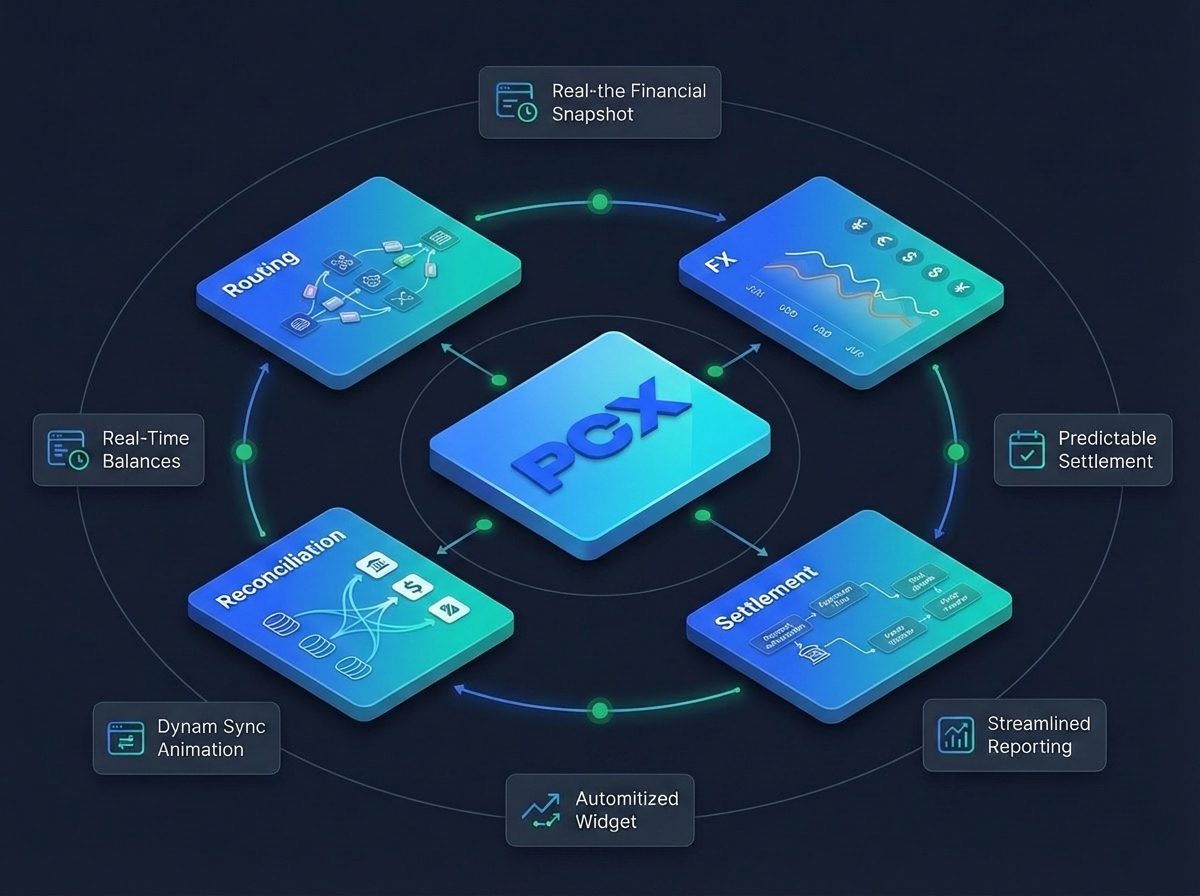
At PCXPay, reconciliation is approached as part of the payment architecture itself. Collections, routing, settlement, and reporting are connected through a unified infrastructure layer so transaction states remain observable from initiation to final settlement.
The goal is not just faster payments.
It is financial clarity.
The Hidden Impact on Growth
The reconciliation tax affects more than operations.
It slows expansion.
Finance teams become cautious about entering new markets because every additional rail introduces more reporting complexity. Product teams hesitate to launch new payment flows because support overhead increases with every exception.
Even customer experience suffers.
When users experience delayed confirmations or inconsistent balances, trust weakens. And in payments, trust disappears faster than it is built.
Most companies think they have a payment problem when they actually have a visibility problem.
The difference matters.
Because payment speed can improve while reconciliation complexity still gets worse underneath.
Learn how PCXPay helps platforms reduce reconciliation overhead through coordinated payment infrastructure built for scale.